How Perplexity Chooses and Cites Sources
Learn how Perplexity retrieves web pages, how PerplexityBot and Perplexity-User differ, and how to make your pages clearer to cite.
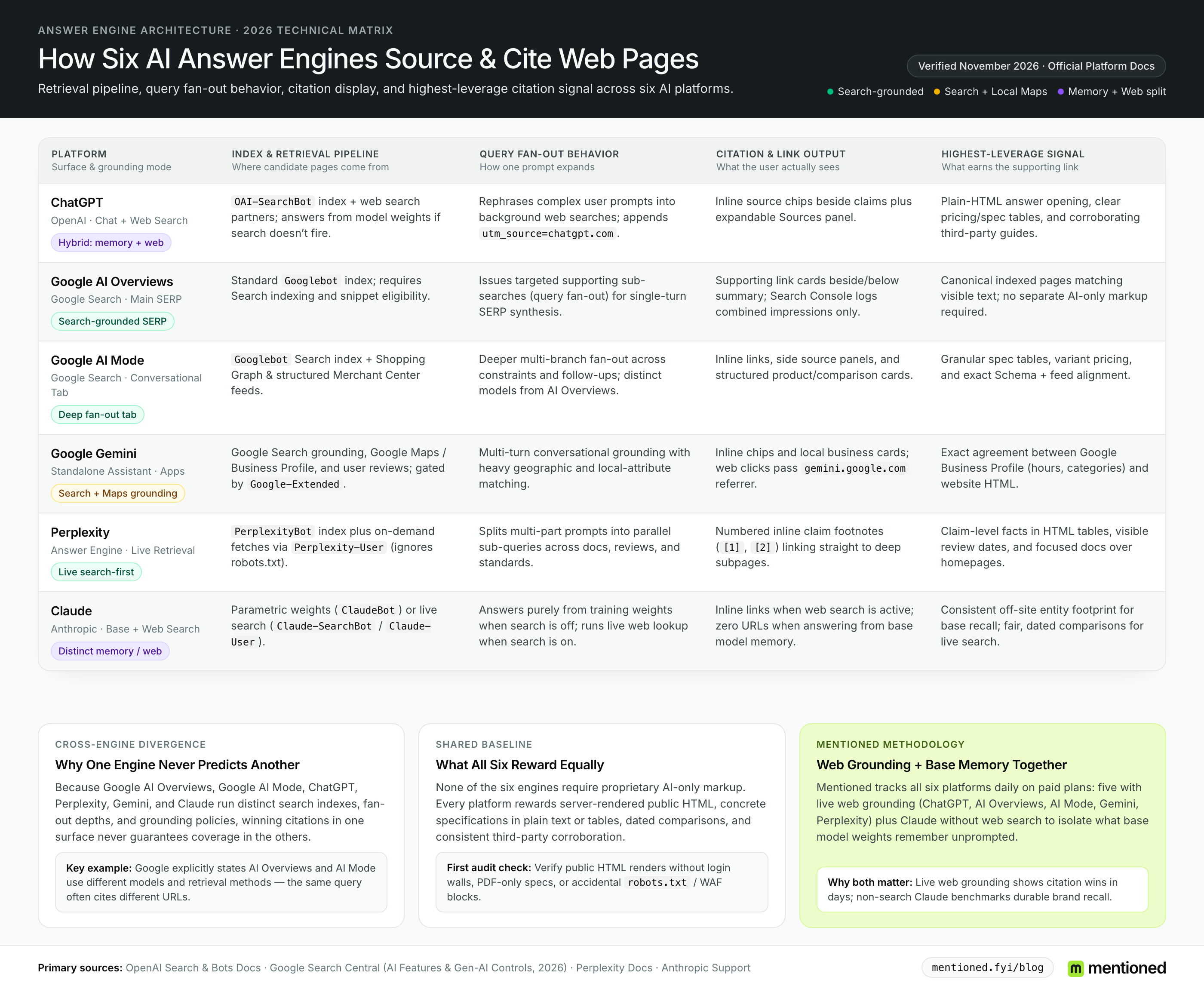
Reference ChartVerified November 2026 from official OpenAI, Google Search Central, Perplexity, and Anthropic platform documentation. Free to save or cite with attribution.
A finance manager asks Perplexity which project accounting tools support multi-currency VAT reporting across the European Union. The answer lists four products, each sentence punctuated by small numbered brackets. Click the bracket beside a claim about country-specific tax exports, and you rarely land on a vendor’s home page. You land on a plain help-center article containing a country matrix and export rules.
In Perplexity, citations are claim-level evidence. Before rewriting a marketing page, open an actual Perplexity answer, click each numbered source, and identify the exact fact that earned the link.
How Perplexity Retrieves and Synthesizes Live Sources
Perplexity is built around live web retrieval rather than answering purely from static training memory. When a user enters a question, the system interprets the intent, runs web searches across its index and live sources, extracts passages that address parts of the prompt, and synthesizes a response with inline numbered footnotes pointing back to the retrieved pages.
For multi-part buyer questions—such as comparing software integrations, regional pricing, or compliance requirements—Perplexity often pulls from several distinct source types in a single answer:
- Primary vendor documentation for technical specs, supported integrations, limits, and current plan tiers.
- Independent comparison guides and reviews for trade-offs, setup effort, and alternatives.
- Official regulatory or standards pages when a question touches legal, tax, or technical definitions.
- Community threads or practitioner write-ups when official documentation stays vague about real-world edge cases.
No third party can inspect Perplexity’s exact internal ranking weights, and results can vary across runs, follow-up turns, and user locations. What you can inspect directly is which claim each numbered link supports—and whether your site supplies clear, verifiable evidence for that exact claim.
PerplexityBot vs. Perplexity-User: Know Which Crawler Visits
Before assuming Perplexity ignored your content, verify that its search crawler can reach your pages. Perplexity documents two distinct crawler identities with very different behavior in Perplexity’s crawler documentation:
PerplexityBotis Perplexity’s search indexing and discovery crawler. It followsrobots.txtrules and surfaces pages so they can be retrieved and cited in answers. Perplexity states thatPerplexityBotdoes not crawl sites to train foundation models.Perplexity-Userfetches a specific page on demand when a user prompts Perplexity about a topic or URL. Because the fetch is triggered by an individual user’s request, Perplexity notes thatPerplexity-Usergenerally ignoresrobots.txt. Site owners who need strict access enforcement must rely on authentication or server/WAF rules using Perplexity’s published user-fetcher IP ranges.
If you want Perplexity to discover and cite your public pages while blocking model-training bots from other vendors, keep your robots.txt rules cautious. Remember how RFC 9309 handles named groups: once you create a User-agent: PerplexityBot section, that bot stops inheriting restrictions from User-agent: *. Either rely on a permissive wildcard group or copy over every private path you still want excluded:
User-agent: *
Disallow: /account/
Disallow: /internal-search/

User-agent: PerplexityBot
Allow: /
Disallow: /account/
Disallow: /internal-search/
Check your live policy on the exact host or subdomain serving your docs—not just your root marketing domain. You can inspect public rules with the AI crawler checker, draft clean rules with the robots.txt generator, or read our full breakdown of robots.txt for AI crawlers. Follow up in your CDN or web application firewall logs as well: an aggressive bot challenge can return HTTP 403 or a CAPTCHA to PerplexityBot even when robots.txt allows crawling.
What Makes a Page Easy for Perplexity to Cite
Once PerplexityBot can fetch your pages cleanly, citation eligibility depends on whether your HTML gives the retrieval system concrete, extractable facts. Pages that consistently earn inline citations tend to share five practical traits:
- Fast, server-rendered public HTML. Keep core specifications, pricing tables, and definitions in plain HTML without requiring login, cookie-banner dismissal, or complex client-side interactions to reveal text.
- Direct answers near the top. State the scope and core answer in the opening paragraph before moving into background context. If a page answers whether your product supports EU OSS VAT exports, say yes or no clearly and list the supported formats right underneath.
- Structured reference tables. Clean HTML tables comparing plans, countries, dimensions, or technical limits are easy for both humans and retrieval systems to parse accurately without misreading prose.
- Verifiable primary references and dates. Link to primary documentation, standards, or changelogs, and label time-sensitive pages with a visible review or effective date. Undated claims force both readers and assistants to guess whether a policy still applies.
- Focused, self-contained subpages. Because a numbered citation sends readers directly into the middle of your site, each key specification or comparison page should identify the product, version, and exceptions without forcing visitors to hunt across five other tabs.
Avoid stuffing promotional superlatives into informational guides. Phrases like “industry-leading compliance engine” give Perplexity nothing verifiable to cite. Listing the exact export file formats, supported tax jurisdictions, and plan tier required gives it a concrete fact worth linking.
Sample Perplexity Citation Audit Table
Use a structured worksheet to inspect how Perplexity currently cites your category. The table below is a sample audit based on a hypothetical B2B accounting vendor evaluating the EU multi-currency VAT question:
| Claim in the Perplexity Answer | Cited Source | Why It Supported the Claim | Action to Take |
|---|---|---|---|
| “Tool A exports country-level VAT summaries in CSV and XML.” | Competitor’s help-center matrix | Plain HTML table lists 27 EU countries and export formats with a current date. | Publish an equivalent supported-countries table in public docs instead of a gated brochure. |
| “Your brand supports multi-currency invoicing but lacks VAT filing exports.” | Two-year-old third-party software review | Outdated review still ranks for the product name plus VAT. | Update your public VAT documentation, then send the reviewer a dated correction link. |
| “Starter plans cap users at five seats.” | Your pricing FAQ page | Clear sentence with exact numeric limit directly under a descriptive heading. | Keep the page maintained and confirm the FAQ matches the pricing table. |
| “Enterprise onboarding takes two to four weeks.” | Community forum thread | No vendor page states typical onboarding timelines publicly. | Add realistic onboarding timeframes and prerequisites to your implementation guide. |
Notice the distinction between a brand mention and a domain citation in the second row: the answer named the business, yet cited an outdated third-party review. Keep those two metrics in separate columns when reviewing results. Our AI visibility metrics guide explains how to score mentions, citations, and accuracy without conflating them.
Track Perplexity Citations Without Guessing
Running one prompt in Perplexity tells you what appeared on that afternoon under one phrasing. It does not tell you whether a doc update improved citation frequency over a month, or whether a competitor quietly took over the footnote slots on your highest-intent comparison questions.
If you want to replace ad-hoc screenshots with a repeatable baseline, Mentioned tracks Perplexity daily on every paid plan—starting at €29/month on Starter (1 brand, 25 tracked questions, 2 markets, excluding VAT)—alongside ChatGPT, Google AI Overviews, Google AI Mode, Gemini, and Claude. Each daily run records brand mentions, position, sentiment, competing brands, and the exact URLs cited across answers so you can spot recurring content gaps before guessing what to rewrite. If you prefer to test a lightweight baseline first, the Free plan tracks 1 brand and 5 questions weekly on ChatGPT with no card required. See full plan limits on the Mentioned pricing page.
A Practical Perplexity Citation Checklist
Pick one commercial or technical question where Perplexity currently cites competitors or outdated directories, then work through this sequence:
- Confirm
PerplexityBotis allowed inrobots.txton the exact host serving your documentation and help pages, and verify server logs return HTTP 200 without WAF challenges. - Inspect the page source (with JavaScript disabled) to confirm critical specs, prices, and tables exist in plain HTML.
- Rewrite the opening section so it states the direct answer, scope, and main exceptions clearly.
- Replace vague marketing bullet points with a structured HTML table or dated reference list that a reader can verify.
- Link to primary standards or related deeper pages so a visitor landing from a numbered citation can complete their decision.
- Recheck a fixed set of buyer questions over several weeks and record which cited URLs change before making further edits.
Frequently Asked Questions
Does Blocking PerplexityBot Stop Perplexity From Visiting a Page?
Blocking PerplexityBot instructs Perplexity not to index your pages for search discovery. However, Perplexity-User fetches pages on demand when a person asks a question or submits a URL, and Perplexity states that it generally ignores robots.txt rules.
Does Perplexity Use PerplexityBot to Train Foundation Models?
According to Perplexity's crawler documentation, PerplexityBot discovers and indexes pages to surface and link in search answers rather than crawling content to train foundation models.
Why Does Perplexity Cite a Deep Help Page Instead of My Home Page?
Perplexity attaches numbered citations to individual claims inside an answer. A focused pricing table, specification sheet, or technical guide usually substantiates a specific claim better than a broad brand overview.
Free 2026 AI Crawler Cheat Sheet and robots.txt Recipes
Keep every search, assistant, and training crawler token in one printable reference — and get notified when major AI providers update their bots.
Check Your AI Visibility
Start free with 5 ChatGPT questions weekly in Mentioned, or test which AI crawlers your website allows.