How to Get Mentioned by Claude: Training Knowledge vs. Web Search
Understand Anthropic's three crawlers, how Claude balances training knowledge with live web search, and how to strengthen brand visibility in Claude.
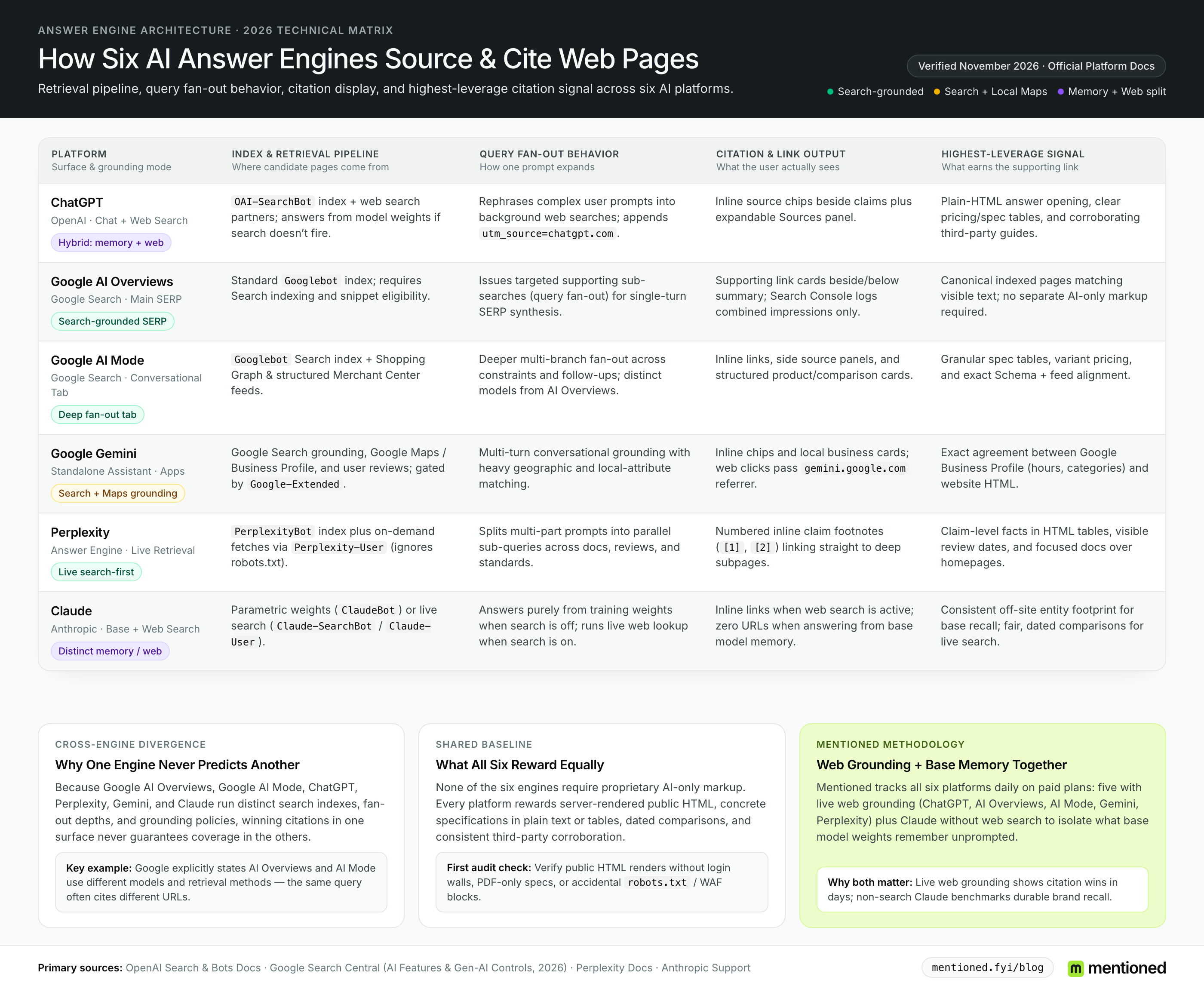
Reference ChartVerified November 2026 from official OpenAI, Google Search Central, Perplexity, and Anthropic platform documentation. Free to save or cite with attribution.
Suppose you run a three-year-old European payroll platform for distributed engineering teams. You ask Claude—with web search switched off—to recommend multi-country payroll tools for EU startups. Claude lists four long-established incumbents and never mentions your company, even though you rank on page one of Google. Open a new chat with web search switched on, ask the exact same question, and Claude retrieves a recent comparison guide that names your product and links to your pricing page.
Same assistant, two completely different mechanisms. Improving visibility in Claude means understanding the gap between what the model carries in its weights and what it pulls from the live web.
Training Knowledge vs. Live Web Search in Claude
Claude can answer a buyer’s question in two fundamentally different ways:
- Training knowledge (parametric memory): When web search is disabled—or when Claude answers directly without issuing a search—every brand name, product capability, and limitation comes from patterns learned during model training up to its knowledge cutoff. Updating your website today will not change a deployed model’s training weights tomorrow.
- Live web search (search-grounded retrieval): When web search is active, Claude queries search results and fetches public web pages to verify current features, pricing, comparisons, and recent launches, attaching inline citations to the pages it reads.
Keep the two modes distinct when planning AEO work:
| Dimension | Training Knowledge (No Web Search) | Live Web Search (Search-Grounded) |
|---|---|---|
| Source of Facts | Patterns learned from public web data and licensed corpora before model cutoff | Live web index plus on-demand page retrieval |
| How Fast Changes Show Up | Slow—requires future model training and release cycles | Fast—as soon as search crawlers re-index updated pages |
| Relevant Anthropic Bot | ClaudeBot |
Claude-SearchBot and Claude-User |
| Primary Brand Levers | Clear entity identity, authoritative docs, and repeated independent off-site coverage | Crawl access, fast public HTML, clear answers, dated specs, and current comparisons |
| Common Failure Mode | Newer brands omitted or older pricing/positioning repeated from years ago | Blocked crawler, script-hidden content, or vague pages skipped for clearer sources |
Neither path replaces the other. A strong search-grounded presence helps capture live citations today, while durable public documentation and third-party authority determine whether future models recognize your brand unprompted.
Anthropic’s Three Bots: ClaudeBot, Claude-SearchBot, and Claude-User
Anthropic is unusually explicit about separating training crawls from live search access. In Anthropic’s crawler documentation, it documents three distinct user-agent tokens, all of which respect robots.txt:
ClaudeBotcrawls public web content that may be used to train future Claude models.Claude-SearchBotindexes public web pages specifically to improve search quality and surface pages in Claude’s web search results.Claude-Userfetches a specific URL on demand when a person asks Claude to read or verify a page during a conversation.
That separation gives site owners a clean policy choice. If your legal or editorial team wants to opt out of foundation-model training while remaining eligible for citations inside Claude’s web search, you can disallow ClaudeBot while allowing Claude-SearchBot (and choosing your preferred policy for Claude-User).
Be careful when writing named rules in robots.txt. Under RFC 9309, adding a named block for a bot overrides the wildcard User-agent: * group, so you must repeat any private path restrictions that still apply. Here is a cautious example that blocks training crawls while letting Claude’s search and user fetchers read public pages (and still keeping /internal-search/ excluded):
User-agent: *
Disallow: /internal-search/

User-agent: ClaudeBot
Disallow: /
Because Claude-SearchBot and Claude-User have no named override above, both inherit the wildcard group: public documentation and product pages stay open, while /internal-search/ stays excluded. Check what your live host actually serves using the AI crawler checker, generate clean templates with the robots.txt generator, or read our full guide to robots.txt for AI crawlers. Also check your WAF or CDN bot rules—blocking Anthropic’s crawler requests at the firewall stops citations even when robots.txt allows them.
How to Strengthen What Claude Knows From Training Data
You cannot buy placement inside a model’s weights, and no single landing page rewrites training memory overnight. What you can build is a clear, verifiable entity footprint that makes your brand unmistakable whenever public corpora are assembled and filtered:
- Publish an unambiguous entity baseline. State plainly what your company does, who it serves, where it operates, and what your flagship products are called across your About page, documentation home, press kit, and official profiles. Avoid clever taglines that hide your actual product category.
- Earn independent, consistent third-party corroboration. Parametric recall correlates strongly with how consistently independent sources describe your brand alongside a specific category or use case—software directories, industry associations, partner ecosystems, open-source repositories, technical reviews, and reputable trade publications. See our off-site AEO citations guide for practical ways to strengthen external references honestly.
- Keep core product documentation public and linkable. Technical guides, API references, compliance pages, and plain-English FAQs attract natural external links and citations far more reliably than gated whitepapers or sales decks.
- Fix contradictory legacy descriptions. If your company pivoted from an agency into a SaaS product—or rebranded three years ago—clean up outdated bios on Crunchbase, partner directories, LinkedIn, and old comparison articles so future training snapshots do not reinforce an obsolete identity.
Also weigh your ClaudeBot policy thoughtfully. Blocking ClaudeBot protects your own domain from direct training crawls, which is a valid business choice for many publishers; just remember that if you block ClaudeBot, Claude’s non-search knowledge of your brand will depend even more heavily on how accurately third-party sites describe you.
How to Earn Citations When Claude Uses Web Search
When buyers use Claude with web search active, your on-page fundamentals matter immediately:
- Serve clean, fast HTML. Put product specifications, plan limits, integrations, and pricing tables directly in server-rendered HTML rather than behind login walls or interactive-only widgets.
- Write fair, structured comparisons. State clear evaluation criteria, disclose trade-offs, and identify who a product fits—and who it does not fit. Balanced pages with concrete facts are easier to cite accurately than one-sided sales copy.
- Date changeable facts. Pricing, supported regions, compliance certifications, and software versions drift quickly. Adding an explicit “Last updated” date and version scope helps both Claude and the reader judge whether a passage is current.
- Verify hosting logs. Confirm
Claude-SearchBotreceives HTTP 200 responses on your priority documentation, pricing, and guide URLs.
How Mentioned Tracks Claude and Why It Matters
Not every AI visibility signal measures the same thing, and pretending otherwise leads to bad editorial decisions. On every paid plan—Starter at €29/month (1 brand, 25 questions, 2 markets), Growth at €79/month (3 brands, 100 questions, 5 markets), and Agency at €199/month (10 brands, 300 questions, 15 markets), all excluding VAT—Mentioned checks 6 AI platforms daily: ChatGPT, Google AI Overviews, Google AI Mode, Gemini, Perplexity, and Claude.
Mentioned intentionally checks Claude without web search, while tracking ChatGPT, Google AI Overviews, Google AI Mode, Gemini, and Perplexity with live web grounding. That contrast is genuinely useful: Claude gives your team a clean daily benchmark of base model memory—whether a leading LLM recalls your brand accurately from training knowledge alone—right beside how web-connected engines cite your live pages. If you want to test prompt tracking before committing to multi-platform monitoring, Mentioned’s Free plan checks 1 brand and 5 questions weekly on ChatGPT with no card required. Review all options on the Mentioned pricing page.
A Practical Claude Visibility Audit
Run this five-step check before changing your crawl policy or rewriting pages:
- Audit
robots.txtand WAF logs forClaudeBot,Claude-SearchBot, andClaude-Useron both your main domain and documentation subdomain. - Test a fixed set of 10 buyer questions in Claude twice—once with web search off, once with web search on—and record mentions, accuracy, and cited URLs separately.
- Identify memory errors vs. retrieval gaps. If Claude omits you only when web search is off, prioritize long-term brand authority and off-site corroboration; if it skips your site even with web search on, inspect crawl access and on-page clarity.
- Inspect cited third-party sources for outdated pricing, old brand names, or missing product capabilities, and send concise factual corrections to editors or directory maintainers.
- Track changes over quarters, not days. Search citations can shift within weeks after page updates; training-knowledge shifts happen across model releases.
Frequently Asked Questions
Can I Block Claude Training While Allowing Claude Search Citations?
Yes. Anthropic separates ClaudeBot (training) from Claude-SearchBot (search indexing) and Claude-User (user-triggered fetches). You can disallow ClaudeBot in robots.txt while keeping Claude-SearchBot permitted.
Why Does Claude Know My Competitor Even Without Web Search?
When web search is turned off, Claude answers from its parametric training knowledge. Brands with long-standing, consistent coverage across authoritative documentation, independent reviews, and public reference sites are more likely to be recalled accurately.
Does Mentioned Track Claude With Web Search Enabled?
No. On paid plans, Mentioned queries Claude without web search on purpose, giving teams a daily read on what the base model knows about a brand from training knowledge alongside web-grounded platforms.
Free 2026 AI Crawler Cheat Sheet and robots.txt Recipes
Keep every search, assistant, and training crawler token in one printable reference — and get notified when major AI providers update their bots.
Check Your AI Visibility
Start free with 5 ChatGPT questions weekly in Mentioned, or test which AI crawlers your website allows.